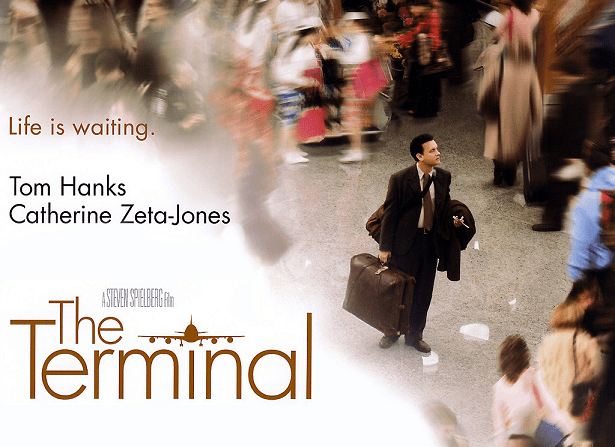
Today’s post has to do with a course I am doing at the BFI in London about Steven Spielberg. I still don’t know how, but here I am preparing a presentation for tomorrow’s class. “E.T” was taken, so I chose to talk about “The Terminal”. Without knowing why, after just watching it, I now know that it was my reconciliation with Spielberg after “A.I” and “Catch me if you can” or “Minority Report”. He had a tendency of making two hours and thirty minutes films that were about ego more than anything else.
I learnt during this course that this was the first film he directed after the 9/11 and I realised why. It has all the elements for a perfect story to an American audience. It was his way to show the world a story about the old America and its possibilities. But above all, it is a story of a good person with nothing to hide; and it gives Tom Hanks a perfect opportunity to show once more the fabulous comedian he is, even though his character keeps fighting to follow a dream and make it true.
Going back to Spielberg’s influences, I would say that this could be considered a modern Frank Capra. It describes the American society and how it works. Viktor Navorski (Hanks character) suffers the worse and best of the Americans. He arrives to live a dream and fulfill his father’s last will. But, once he lands, he’s informed that his country no longer exists and therefore, he cannot leave the airport because his passport is no longer valid. Where there’s a protagonist, there must be also an antagonist, and that is Dixon (Steve Tucci). He is in charge of the security at the airport and he is evil enough to keep making impossible for our hero to achieve his goal.
More than a film, this becomes a tale. The script carries the audience masterfully through the main plot but without losing sight of the subplots and illuminating the silver linings of the American dream with brush strokes. Spielberg filmed this movie to show how strongly he felt about the United States; the two sides of a coin, but good always conquers evil. What a better way to portrait the Americans than at JFK, probably the most well known aiport and also the biggest. The whole film happens within the airport. We, as an audience, feel a mix of claustrophobia and agoraphobia, it’s opened and closed at the same time.
As usual, when I watch a good Spielberg film, tears come to my eyes. Same way Spielberg enhances my inner child, he also brings my desire to be a better person and give the best of me. Like in every tale, there’s a moral attached to it. Mine after just watching this wonderful film once more is: “Be true to yourself!”
BCV79
El post de hoy está relacionado con el curso que estoy haciendo en la filmoteca de Londres sobre Steven Spielberg. Todavía no sé cómo, pero aquí estoy preparando una presentación para la clase de mañana. “E.T” estaba cogida, así que elegí hablar de “La Terminal”. Sin saber por qué, después de acabar de verla, ya sé por qué me gustó tanto; porque fue mi reconciliación con Spielberg después de “Inteligencia Artificial” y “Atrápame si puedes” o “Minority Report”. Le dio porhacer películas de dos horas y media que estaban más motivadas por el ego que cualquier otra cosa.
Gracias a este curso, he caído en la cuenta de que esta fue la primera película que dirigió después de los atentados de las Tores Gemelas y también me di cuenta de por qué. Tiene todos los elementos de una historia perfecta para una audiencia americana. Era su manera de mostrar al mundo la historia del sueño americano. Pero sobre todo, es una historia de una persona corriente que no tiene nada que ocultar y que le da a Tom Hanks la oportunidad perfecta para mostrar una vez el gran cómico que es, incluso a pesar de las dificultades a las que se enfrenta su personaje y que lucha por conseguir su sueño.
Volviendo a las influencias de Spielberg, yo diría que esta película podría considerarse un moderno Capra. Describe la sociedad estadounidense y cómo funciona. Viktor Navorski (personaje de Hanks) sufre lo peor y lo mejor de los estadounidenses. Llega a vivir un sueño y cumplir la última voluntad de su padre. Pero, una vez que aterriza, le informan de que su país ya no existe y, por lo tanto, no puede abandonar el aeropuerto porque su pasaporte ya no es válido. Donde hay un protagonista, tiene que haber también un antagonista, y ese es Dixon (Steve Tucci). Él está a cargo de la seguridad del aeropuerto y es lo suficientemente malvado para hacerle imposible a nuestro héroe lograr su objetivo.
Más que una película, se acaba convirtiendo en un cuento. El guión lleva a la audiencia con maestría a través de la trama principal, pero sin perder de vista los argumentos secundarios e iluminando con pinceladas aquí y allí el sueño americano. Con esta película, Spielberg firma una declaración de amor en toda regla, ama profundamente a su país y las dos caras de una moneda, pero el bien siempre vence al mal. Qué mejor manera de retratar a los norteamericanos que en el JFK, probablemente el aeropuerto más conocido y también el más grande del país. Toda la película sucede dentro del aeropuerto. El público asiste a este espectáculo con una mezcla entre claustrofobia y agorafobia.
Como es habitual, cuando veo una buena película de Spielberg, las lágrimas empañan mis ojos. Spielberg consigue conectar con mi niña interior, a la vez que provoca que quiera ser mejor persona y dar lo mejor de mí misma. Como en los cuentos, al final hay moraleja. La mía después de haber vuelto a verla: “Sé fiel a ti mismo”
BCV79
 Blanca in Movieland