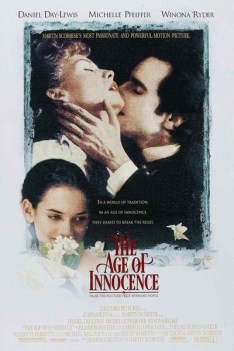
Life gets in the way, so many films, the Oscars coming up and so little time for everything else, including 5 visits to the cinema to relive “La la land” (couldn’t help it and it won’t be the last one)… I don’t know where to begin with and I have long abandoned you since I last wrote here… I will begin by telling you that I am doing the zillionth film course. This time is non other than Marty, I mean Martin Scorsese (who comes next Wednesday to the BFI for a talk, lol). And my teacher, who is such a nice fella, asked us the other day if we wanted to make a presentation about any of our favourite Scorsese’s films. I did not have time enough to raise my hand and say that I wanted to do it on “The Age of Innocence”.
My teacher, John Wischmeyer, American by birth and English by adoption, and I complement each other wonderfully. Last June, I proposed to present “The color purple”, because I told him that I liked it and he said that I would probably do more justice than him because he had never liked it. That was after I presented “The terminal”, which at the same time, made it as an article in this blog. Today, before starting the class, he asked me if I thought this movie was typical of Scorsese. And I told him 50-50. On the one hand, it is technically pure Scorsese (one take sequences, wonderful use of the editing, silences, glances, framing…). But, on the other, it is one of the most feminine films of his filmography (only the credits are 3 minutes of germinating flowers) and one of his most personal because he also cowrites the script. He has two magnificent actresses (Michelle Pfeiffer and Winona Ryder, I’m sorry for the order, but I think the first one is more protagonist than the second one, and besides, I prefer Pfeiffer over Ryder… that also came out of my mouth in today’s presentation, couldn’t help it but it’s not secret) And perhaps the best actor of the moment, Daniel Day-Lewis. You can not ask for more … well yes, let it be a love triangle.
My friend Santi, whom I will see in less than two weeks for the Oscars, always says he does not understand how I liked this movie, because for him it was very boring. And that’s what my teacher told me today. Maybe because I find it feminine, is the reason why they don’t like it. Such a shame, because aesthetically I think it’s the perfection made movie. It has it all. It’s a bit like Carol (okay, I have not yet written the article about it… I don’t know what I’m waiting for after only 15 viewings in the cinema… hehehehe), because it seems that nothing happens but everything is happenning in the subtext, in those gazes, admiring one another in a forbiden silence… and that sexual tension between the protagonists that you notice and feel in the atmosphere. With a trio like that, it’s hard not to get a master piece.
As I proceeded to revisit the film, I acquired it (thanks Amazon, it only costed £3) and I started watching it over the weekend. I even had to pause it to comment on it out loud in my flat and on my own (yes, I have a very rich relationship with myself). And I rejoiced because I had forgotten how good it was. I remembered it good, but this time I really savored it. In addition, it has been good for me to be in the middle of the course, because I have learned the special place New York occupies in Scorsese cinema (it is just another physical space and always in relation to the characters that inhabit that film) or Catholic symbolism and his particular spiritualism (I know that Fernando Trueba said that his God was Billy Wilder … but, if Mr. Scorsese puts himself at my disposal next Wednesday, I will have no choice but to tell him that even though we share God, that he is my cinematographic one).
On top of that, I didn’t realise how close “Dangerous Liaisons” and “The Age of Innocence” were, mainly ’cause they both share Michelle Pfeiffer. Today, when I was thinking about how I would structure my presentation, I even found more similarities. These two masterpieces of the twentieth century are just about a century apart. In both there are opera scenes, but Martin uses the space perfectly as he pleases and generates pauses, silences, veiled looks, whispers … oh, come on, one does nothing but sigh.
As Almodóvar said in his talk last year, how important color is in a film and how much you can convey using it correctly. Every time Winona Ryder appears, she is dressed in white or light colors – a symbol of purity or innocence, depending on how you see it. But every time Miss Pfeiffer shows up, hold on ladies and gentlemen, electric blues, red crimson… dear and loving God, brace yourselves!
Scorsese leads us along the New York of 1870’s and, adapting Edith Wharton’s novel, uses the voice-over which is a fantastic resource as a narrator but also as omnipresent God, because that voice explains how New York society works and what are the rules of the game; the rules that Archer and Olenska skip as they please. Another great resource are the zenith shots that make us feel total voyeurs. We have a privileged place and the director leads our looks to where he wants with quick close ups of a glove and how Archer unbuttons it looking for access to the sinful flesh of Madame Olenska. There are no nudes, but I’ve never seen such an erotic scene with a simple glove that opens from button to button… shivers just thinking about it.
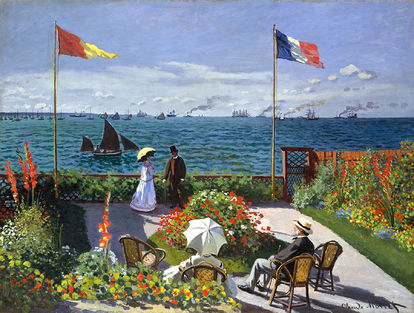
To finish off, Scorsese uses classic music (Radeztky March and several Strauss’ Waltzes), impressionist paintings and other works of art that spread between shots. Speaking of Impressionists, there is a moment in the film where Archer goes to look for Ellen and finds her staring at the sea (it reminds me of a Monet Painting). There is a lighthouse and a boat. Archer swears that if she turns before the ship goes through the lighthouse, she’ll go fetch her. What a great leap of faith, to leave such decision to fate. Pfeiffer is no more than a temptation throughout the whole film, like the temptations of Jesus Christ. And poor Archer, he resists all that he can but he is so elegant in the end, that he prefers being truthful and honourable and ends up carrying a corteous life as an attentive husband instead of having a lustful and passionate love.
For those who want to enjoy a film well cooked on a slow fire and with all the ingredients for success, it won’t disappoint you. And you will see the three actors at the pick of their careers.
BCV79
————————————————————————–
Se me acumula el trabajo, tantas películas, los Oscar y tan poco tiempo para todo lo demás, entre repetir “La ciudad de las estrellas” 5 veces y un largo etcétera… Como no sé por dónde empezar y hace tiempo que os tengo abandonados, …empezaré contando que estoy haciendo el enésimo curso de cine. Este es sobre Martin Scorsese (que encima viene el miércoles que viene a dar una charla a la filmoteca de Londres). Y mi profe, que es majete, nos preguntó el otro día que si queríamos hacer una presentación sobre alguna de nuestras películas preferidas de Scorsese. Así que, me faltó tiempo para levantar la mano y contestar rotundamente que quería hacerla sobre “La edad de la inocencia”.
Mi profesor, John Wischmeyer, americano de nacimiento e inglés de adopción, y yo nos complementamos de maravilla. Ya en el curso en junio del año pasado, me propuso presentar “El color púrpura”, porque le dije que me había gustado y dijo que yo le haría más justicia que él porque no le había gustado nunca. Eso fue después de presentar “La terminal”, que me sirvió para un artículo en este blog. Hoy antes de comenzar la clase, me ha preguntado si creía que esta película era típica de Scorsese. Y le dije que mitad y mitad. Por un lado, es técnicamente puro Scorsese (planos secuencia, maravilloso empleo del montaje, silencios, miradas, encuadres…). Pero, por otro, es una de las películas más femeninas de su filmografía (sólo los títulos de crédito son 3 minutos de flores germinando) y una de las más personales porque también cofirma el guión. Tiene dos pedazo de actrices (Michelle Pfeiffer y Winona Ryder, lo siento por el orden, pero considero a la primera más prota que a la segunda; y, además, me cae mejor…eso se me ha escapado en la presentación de hoy) y quizás al mejor actor del momento, Daniel Day-Lewis. No se puede pedir más…bueno sí, que sea un triángulo amoroso.
Mi amigo Santi, al que veré en menos de dos semanas para ver los Oscars, siempre dice que no entiende cómo me gustó esta peli, porque a él le parece aburridísima. Y es lo mismo que me ha dicho mi profesor hoy. Quizás porque yo la encuentro femenina, sea la razón por la cual a ellos no les guste. Una pena, porque estéticamente creo que es la perfección hecha película. Lo tiene todo. Es un poco como Carol (vale, todavía no he escrito el artículo sobre ella…y a qué espero después de sólo 15 visionados en el cine…jijijijijij), porque parece que no pasa nada pero tiene un fondo de armario ropero…y esa tensión sexual entre los protagonistas que se nota y se siente en el ambiente. Con un trío así, es difícil que no te salga un peliculón.
Ante la tarea de la presentación, me apropié de una copia en DVD (gracias Amazon, porque sólo me costó 3 libras) y me puse a verla este fin de semana pasado (entre película y película de la lista de los Oscars). Y hasta tenía que ir parándola para comentar en alto y regocijarme porque me había olvidado de lo buena que era. La recordaba buena, pero esta vez la he saboreado de verdad. Además, me ha venido bien estar a mitad de curso, porque he aprendido el lugar que ocupa Nueva York en el cine de Scorsese (es simplemente un espacio físico y siempre en relación a los personajes que habitan la película) o los simbolismos católicos y la particularidad espiritualidad del maestro (ya sé que Fernando Trueba dijo que su Dios era Billy Wilder…pero, como se me ponga a tiro el señor Scorsese, no me va a quedar más remedio que decirle que compartimos Dios, pero que él es el mío cinematográfico).
Encima, he encontrado el nexo de unión entre esta película y “Las amistades peligrosas”, claramente Michelle Pfeiffer. Hoy, cuando pensaba en cómo iba a estructurar mi presentación, lo he visto claro. Estas dos obras maestras del siglo XX, distan aproximadamente un siglo entre ellas. En las dos hay escenas de ópera, pero Martin utiliza perfectamente el espacio a su antojo y genera pausas, silencios, miradas veladas, susurros….ay, vamos, que una no hace más que suspirar.
Como dijo Almodóvar en su charla del año pasado, qué importante es el color en una película y cuánto puedes transmitir utilizándolo correctamente. Cada vez que aparece Winona Ryder, va vestida de blanco o de colores claros – símbolo de pureza o de inocencia, según se mire. Pero, cada vez que la señora Pfeiffer asoma, agárrense damas y caballeros, azules eléctricos, rojos carmesíese…madre del amor hermoso.
Scorsese nos lleva de la mano por el Nueva York de 1870 y, al adaptar la novela de Edith Wharton, utiliza la voz en off que es un recurso fantástico como narrador pero como Dios omnipresente, porque esa voz nos explica cómo funciona la sociedad neoyorquina y cuáles son las reglas del juego, que Archer y Olenska se encargan de saltarse a la torera. Otro gran recurso son los planos cenitales que nos hacen sentir totalmente voyeurs. Tenemos un lugar privilegiado y el director dirige nuestras miradas hacia donde quiere con rápidos planos detalle de un guante y cómo lo desabotona Archer buscando acceder a la carne pecaminosa de Madame Olenska. No hay desnudos, pero nunca he visto una escena tan erótica con un simple guante que se va abriendo botón a botón….escalofríos sólo de pensarlo.
Ya para rematar, Scorsese utiliza a su antojo música clásica (Marcha Radeztky y varios valses de Strauss), cuadros impresionistas y otras obras de arte que disemina entre plano y plano. Hablando de impresionistas (es que me recuerda a uno de mis cuadros preferidos de Monert), hay un momento en la película en el que Archer va a buscar a Ellen y la encuentra mirando al mar. Hay un faro y un velero que navega en ese momento. Archer se jura que si ella se gira antes de que el barco atraviese el faro, irá a buscarla. Qué gran jugada del destino, dejar al azar semejante decisión. El caso es que Pfeiffer no deja de ser más que una tentación, como las tentaciones de Jesucristo. Y el bueno de Archer, se resiste todo lo que puede y es tan elegante, que se queda sin su amor apasionado en pos del honor de ser un caballero y un atento esposo.
Ahí queda eso, para los que queráis disfrutar de una película bien cocinada a fuego lento y con todos los ingredientes para el éxito, no os va a defraudar. Encima veréis a los tres protagonistas en la cúspide de sus respectivas carreras.
BCV79
 Blanca in Movieland